> For the complete documentation index, see [llms.txt](https://docs.hyperswitch.io/llms.txt). Markdown versions of documentation pages are available by appending `.md` to page URLs; this page is available as [Markdown](https://docs.hyperswitch.io/integration-guide/workflows/vault.md).
# Vault
Juspay Hyperswitch Vault — secure, modular payment method storage with flexible PCI compliance options
Juspay Hyperswitch Vault is a PCI-compliant service for securely storing customer payment methods (cards, wallets, bank accounts) and generating reusable tokens (`payment_method_id`). It can be used **standalone** (vault-only, no orchestration) or **alongside** the Hyperswitch Payments Orchestrator.
### Key Features
* **PCI DSS Compliant Storage** — Card data is stored in Juspay's certified vault; your servers never handle raw card numbers.
* **Reusable Tokens** — Every stored payment method gets a unique `payment_method_id` that works across new payments, recurring charges, and MITs.
* **Network Tokenization** - When it is enabled for the profile and the token service is configured, saving an eligible card can provision a network token. See [Network tokenisation](/other-features/network-tokenisation.md) for prerequisites, supported defaults, and fallback behavior.
* **Flexible Deployment** — Deploy as a standalone vault service, integrate with Juspay's hosted infrastructure, self-host with your own PCI-compliant environment, or connect third-party vault providers (VGS, TokenEx, etc.).
* **Proxy Payments** — Send PSP API calls through the Vault Proxy so raw card data never touches your servers or the PSP directly.
* **Customer Payment Method Management** — Customers can view, add, and delete saved cards via an embeddable SDK widget.
***
### Getting Started with Vault
Integration
How to connect to the Vault — Server-to-Server API or the Vault SDK (React / JS)
***
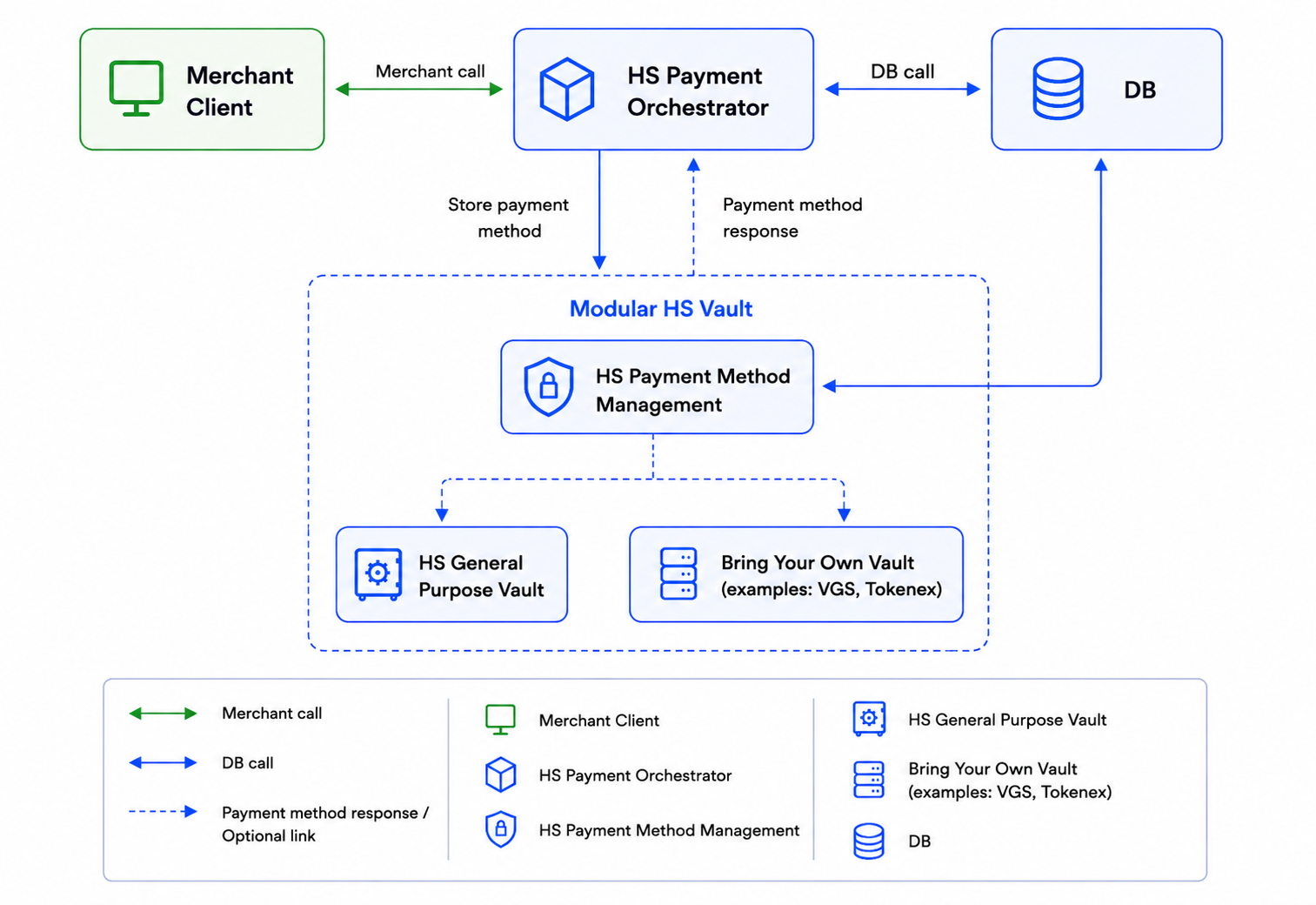
### Modular Vaulting Architecture
Modular Vaulting is the foundation of Hyperswitch's payment infrastructure — it gives merchants the flexibility to use Hyperswitch's built-in PCI-compliant vault or connect any third-party vault provider, without re-architecting their payment stack.
Merchants can start with the simplest model and migrate to a more sophisticated one as their compliance posture or infrastructure evolves. All models share the same `payment_method_id` token standard.
***
### When to Use Vault Standalone vs. with the Payments Orchestrator
| | Vault Standalone | Vault with Orchestrator |
| ------------------ | ----------------------------------------------------------------------------------------------- | ------------------------------------------------------------------------------------------- |
| **Purpose** | Store cards and generate tokens; payments are made separately via your own or a third-party PSP | Store cards **and** process payments through Hyperswitch routing, retries, and analytics |
| **Typical flow** | Vault-Then-Pay using your own payment infrastructure or Proxy API | Pay-Then-Vault (card saved after payment) or Vault-Then-Pay via Hyperswitch Orchestration |
| **PCI scope** | Managed entirely by Juspay Vault | Managed by Juspay (SaaS) or shared (self-hosted) |
| **Where to start** | [Vault Integration](/integration-guide/workflows/vault/integration.md) | [Vault with Payments Orchestrator](/integration-guide/payment-suite/payment-method-card.md) |
---
# Agent Instructions
This documentation is published with GitBook. GitBook is the documentation platform designed so that both humans and AI agents can read, navigate, and reason over technical content effectively. Learn more at gitbook.com.
## Querying This Documentation
If you need additional information that is not directly available in this page, you can query the documentation by asking a question.
Perform an HTTP GET request on the following URL with the `ask` and `goal` query parameters:
```
GET https://docs.hyperswitch.io/integration-guide/workflows/vault.md?ask=&goal=
```
`ask` is the immediate question: it should be specific, self-contained, and written in natural language.
`goal` is what the user is ultimately trying to achieve, the reason they need the answer. Sharing it helps GitBook give you a better, more relevant answer. A goal is most helpful when it describes the outcome the user wants rather than restating the question. For example, with `ask=how do I create an API token`, a goal like `automate deployments from our CI pipeline` lets GitBook tailor the answer to that use case.
The response will contain a direct answer to the question and relevant excerpts and sources from the documentation.
Use this mechanism when the answer is not explicitly present in the current page, you need clarification or additional context, or you want to retrieve related documentation sections.